
Lyon County Court Records After a Jail Arrest
The local path is arrest, booking at the Lyon County Detention Facility, video arraignment, District Attorney review, and then case activity in the court with jurisdiction. The county jail court page says inmates are arraigned by video telecommunications within 72 hours of arrest, excluding weekends and holidays. That first appearance is not the same as a final filing decision. It is the point where the court addresses custody, release terms, the next date, and the case route.
The Lyon County jail court-information page also says court status comes from the court of jurisdiction. That matters because booking charges may be broad intake labels, while the later court record reflects the charges the Lyon County District Attorney chooses to file. Use jail inmate records for current custody, booking status, and app-based inmate search. Use jail mugshots for booking-photo request routes. Court records after a jail arrest are the charge and case history that follows the booking.
For a visual check on the local first-appearance route, the county posts its court timing and contacts on the official jail court page. The screenshot below comes from the official Lyon County Court Information page.
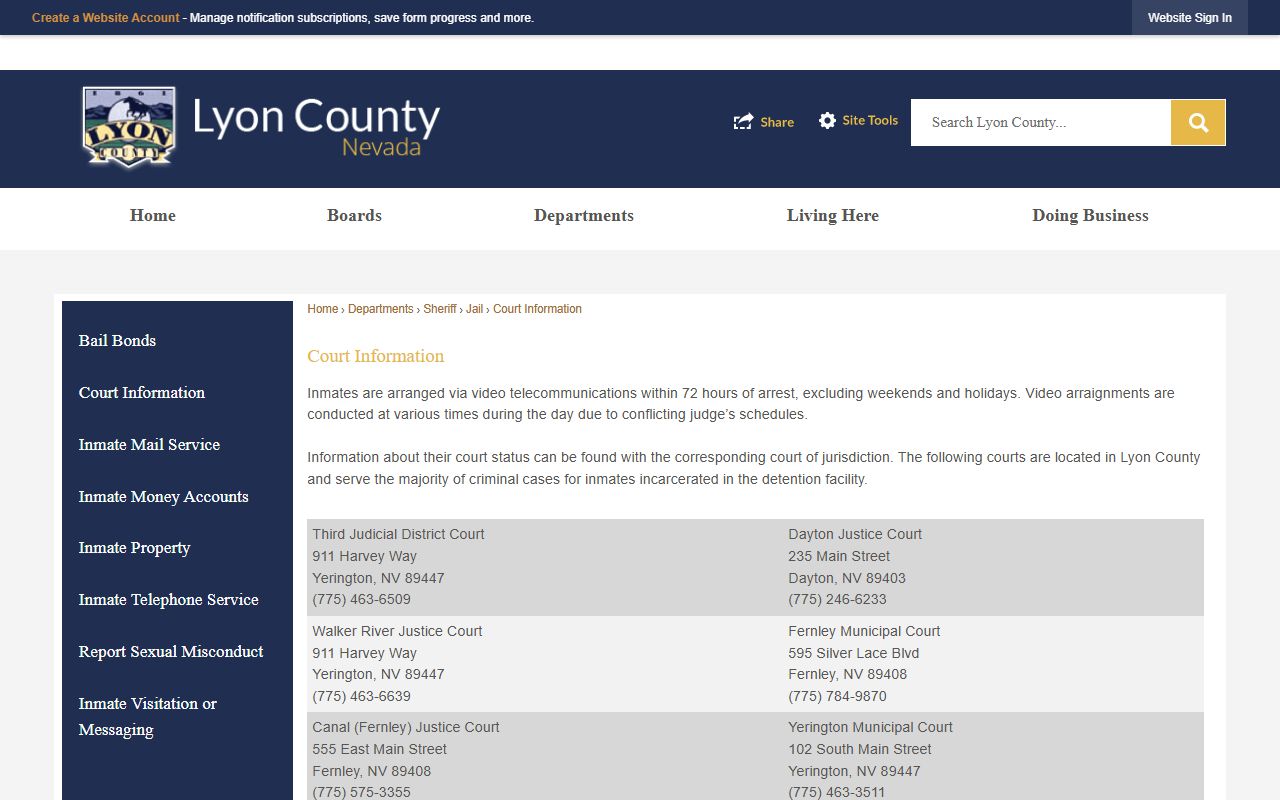
That page is useful when a new jail arrest has not yet produced a detailed public case entry, because it identifies the video arraignment window and the court-contact fallback.
Find Lyon County Court Records After Arrest
Lyon County court records after an arrest may appear in the Nevada court case-search system linked by local court pages, but the research did not expose a simple static field list because the portal loads through a JavaScript shell. Local pages still point users toward the court case-search route for public case information. If the search does not return a new arrest right away, check the jail custody route first and then contact the court that matches the case level or city.
- Start with the court most likely to handle the matter: justice court for initial felony proceedings and many misdemeanors, municipal court for city ordinance or city misdemeanor matters, or district court for felony and gross misdemeanor criminal cases.
- Search by defendant name if a case number is not known. Name spelling and middle initials can affect results.
- Open the case entry and compare the filed charge list with any jail booking information. A jail arrest can begin under one charge label and later move under a different complaint or information.
- Review each charge status, next hearing, disposition, and bond or release notation. If the case is active and the report is not released by sheriff records, use the District Attorney route described below.
The court path is different from the public-records path. The sheriff's public records request form is used for reports, photos, and records not visible through ordinary lookup channels. It warns that reports in active prosecution cannot be released by the Records Division and must be requested through the District Attorney or Juvenile Probation when that rule applies.
| Search or request field | Where it helps | Lyon County note |
|---|---|---|
| Defendant name | Court case search, court clerk request | Most useful when a case number is not known. |
| Case number | Court case search, clerk counter, DA status question | Best match once a charge has been filed. |
| Incident or report number | Sheriff records request | Used for law-enforcement reports, not always court cases. |
| Date and location | Records request and clerk routing | Helps sort Fernley, Dayton, Walker River, Yerington, and county cases. |
| Charge or citation description | Court clerk or prosecutor route | May differ between the jail booking and the filed court record. |
Lyon County Courts After Jail Arrest
The same jail booking can lead to different courts. The Third Judicial District Court is at 911 Harvey Way in Yerington and handles felony and gross misdemeanor criminal jurisdiction, along with appeals and other case types. Walker River Justice Court is also at 911 Harvey Way and hears misdemeanor criminal cases, gross misdemeanor criminal cases, and felony matters for initial proceedings. Dayton Justice Court is at 235 Main Street. Canal/Fernley Justice Court is at 555 East Main Street. Fernley Municipal Court is at 595 Silver Lace Boulevard, and Yerington Municipal Court is at 102 South Main Street.
Municipal courts generally matter when the arrest is tied to a city case. Justice courts are common for first appearances, preliminary matters, misdemeanors, and felony starts. District court becomes central for filed felonies and gross misdemeanors. If a person was arrested by a tribal, state, municipal, or outside agency but booked into the county jail, the jail location does not by itself prove which court owns the charge.
The district court page is a good example of the local court record boundary. The screenshot below is from the official Third Judicial District Court page.
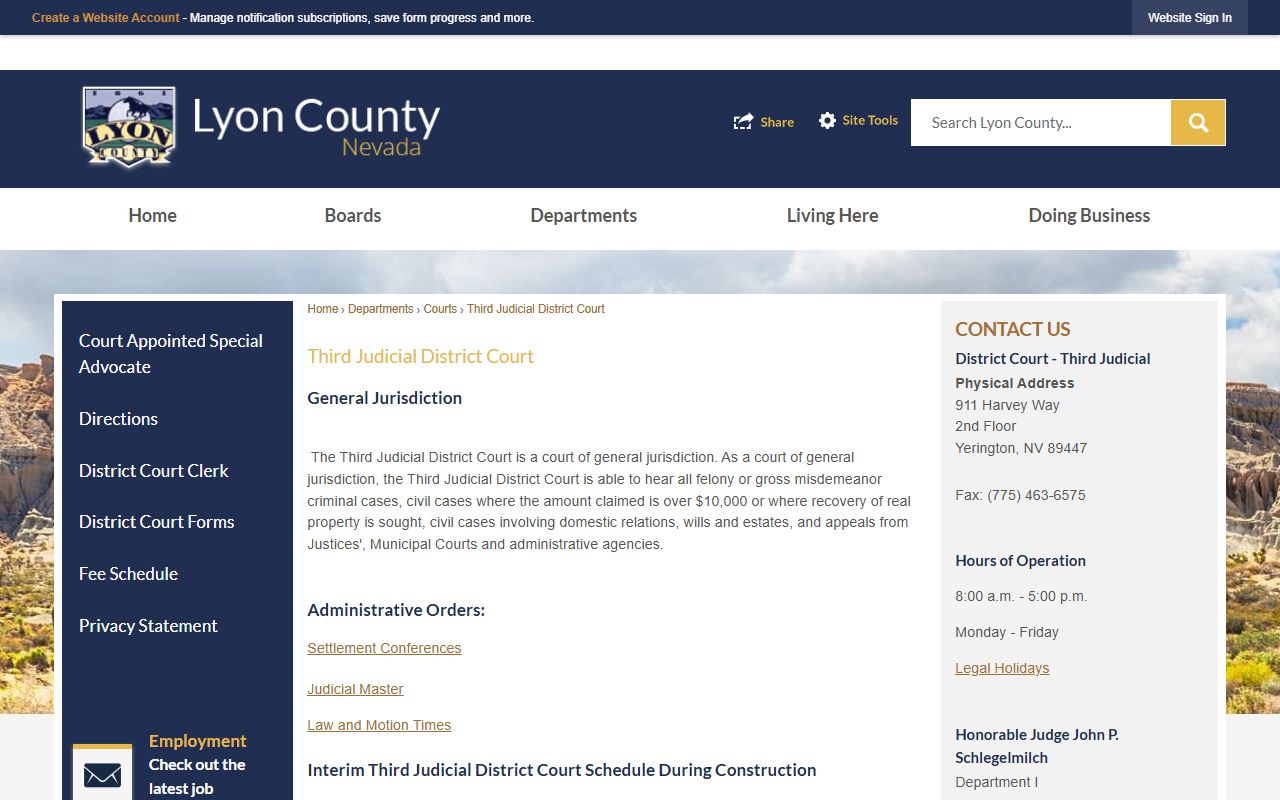
Use the court page to confirm jurisdiction and clerk contact details before assuming a jail case is already visible in a statewide search result.
Lyon County Arrest Charging Documents
After a Lyon County jail arrest, the court record begins to take shape when a charging document is filed or when the case is routed for initial appearance. Nevada practice can involve a complaint, information, indictment, citation, or amended charging document, depending on the level and posture of the case. The key point for record lookup is simple: a booking charge is not always the filed charge.
| Document type | Common use | Record effect |
|---|---|---|
| Criminal complaint | Often starts a misdemeanor case or an early felony matter in justice court. | Creates a public charge record if not confidential or sealed. |
| Information | Prosecutor-filed document used after felony or gross misdemeanor review. | May replace or refine the arrest charge that appeared at booking. |
| Indictment | Grand jury charging document for serious or complex cases. | Can move a case into district court without the same first-step record trail. |
| Citation or notice | Lower-level matters or cite-and-release cases. | May produce a court case without a long jail stay. |
| Amended complaint or information | Used when charges are changed, added, or narrowed. | Explains why old jail and court records may not match. |
DA Review of Lyon County Charges
The Lyon County District Attorney, Stephen B. Rye, prosecutes criminal cases for the county and represents the State of Nevada in juvenile matters. The DA's filing role is the bridge between a jail arrest and the formal court record. Law enforcement may book a person on suspected charges, but the prosecutor decides what to file, amend, dismiss, or pursue after reviewing reports and evidence.
The DA route is especially important during active prosecution. The sheriff's records material says reports in active prosecution are not released by the Records Division. The DA FAQ also says police reports generally are not released to anyone other than the defendant or defense attorney unless Nevada law allows release to someone else. Staff may provide general case-status information, but they cannot give legal advice or disclose every detail of an active prosecution.
Lyon County Charge Status
Charge status is the part of court records after a jail arrest that readers most often misread. Pending does not mean proven. Dismissed does not always mean the arrest record vanishes from every system. Reduced may mean a plea agreement, a prosecutorial decision, or a court ruling. A no-charge release in jail statistics can mean that custody ended without a filed case, but the records route still depends on the exact agency and document.
| Status | What it means | Lookup caution |
|---|---|---|
| Pending | The charge is active and not finally resolved. | Reports may be restricted during prosecution. |
| Amended | The filed charge was changed after the first record entry. | Compare the docket to the original booking charge. |
| Reduced | A lower charge replaced or resolved a higher charge. | The conviction, if any, may not match the arrest label. |
| Dismissed | The charge was ended without a conviction on that count. | Sealing may still require a separate court process. |
| No charges filed | Custody or booking ended without a filed criminal charge. | Check records-request rules before assuming all records are public. |
Bond Records After Lyon County Arrest
Bond and release facts often appear alongside court records after an arrest, but the bail payment process is handled through the jail and Justice Complex. The official Lyon County bail page says bonds are accepted in the main lobby of the Lyon County Justice Complex 24 hours a day. Cash, cashier's checks, and money orders must be in the exact bond amount. Credit or debit card payments can be made through allpaid, through a kiosk, or through a bail bond agent, with vendor fees.
The local pay location code is 4211. A valid ID is required for bond transactions. The county cautions that most bond transactions are processed within the hour, but release may take up to five hours. Bond does not override every hold. A person may remain in custody on a detainer, another agency hold, probation matter, ICE hold, tribal authority issue, or transfer order even after one bond problem is solved.
| Release term | How it works in records |
|---|---|
| Cash bail | Money is posted directly in the required amount, often shown as a release reason or bond condition. |
| Surety bond | A bond agent posts a bond under court-approved terms. |
| Own recognizance | The court releases the person without posted money, usually with appearance conditions. |
| Hold authority | Another legal authority may block release even when a local charge has a bond amount. |
Warrants Before Lyon County Arrest
Lyon County did not have a confirmed public online active-warrant list in the official sheriff pages reviewed. The 2024 annual report did confirm that the Records Division entered arrest warrants, and warrants can appear in the path from missed court to booking. A bench warrant usually begins with a missed hearing or court order. An arrest warrant comes from a judge's finding that law enforcement has legal grounds to arrest. A probation, parole, tribal, municipal, or outside-agency warrant can also lead to a county jail booking.
For a warrant tied to a case, contact the issuing court or counsel rather than relying only on an inmate search. Court staff can provide general procedural information and access to public records, but they cannot give legal advice. If no court is known, the sheriff records route and court search fields can help identify the source of the warrant.
Charges vs Convictions
A charge is an accusation in a court record. A conviction is the result of a guilty plea, no-contest plea accepted by the court, or trial verdict. This distinction is critical in Lyon County court records after a jail arrest because the first charge list can change before final judgment. A person can be booked, charged, released, dismissed, or later convicted on a different count.
| Point of comparison | Charge | Conviction |
|---|---|---|
| Case stage | Accusation filed or alleged after arrest. | Final finding or plea accepted by the court. |
| Proof level | Based on probable cause or prosecutorial filing. | Requires proof beyond a reasonable doubt or a valid plea. |
| Record meaning | Shows what was alleged at that stage. | Shows the legal outcome on that count. |
| Search caution | Can be amended, reduced, or dismissed. | May affect sentencing, supervision, and future sealing timelines. |
Sealed vs Expunged Records
Nevada generally uses record sealing language, not broad expungement language. NRS Chapter 179 governs many criminal record sealing rules, while NRS Chapter 179A deals with criminal-history records and dissemination. A sealed record is restricted from ordinary public view by court order. It is not the same as saying every trace was physically destroyed.
| Point of comparison | Sealed | Expunged |
|---|---|---|
| Nevada wording | The main Nevada path for eligible criminal records. | Not the usual Nevada term for most adult criminal records. |
| Public visibility | Restricted after a valid court order. | Often means erased or treated as never existing in other states. |
| Agency access | Some government or justice uses may still be allowed by law. | Depends on the jurisdiction and statute. |
| Practical step | Check eligibility, file in the proper court, and follow Nevada sealing procedure. | Do not assume this label applies to a Nevada case. |
Sealing is not automatic just because a Lyon County arrest did not lead to conviction. The court record, sheriff records, prosecutor records, and criminal-history systems may each have different rules. A person seeking sealing should use the Nevada court process or legal counsel rather than asking the jail to remove a court case.
Restricted Lyon County Arrest Records
Public access starts with Nevada's Public Records Act, NRS Chapter 239, but access is not unlimited. Active prosecution reports, juvenile matters, sealed records, confidential victim information, medical information, and ongoing investigative material may be withheld or routed to a different office. The sheriff's public-records form also has fee and payment rules, and the records request form requires photo ID follow-up for some releases.
Background checks add another limit. A casual public lookup of court records after a jail arrest is not the same as an employment, tenant, credit, or insurance background report. Consumer-reporting use must follow the Fair Credit Reporting Act and other applicable law.
Important: Do not use casual Lyon County court or jail lookup results for credit, employment, housing, insurance, or other FCRA-covered decisions.